Author
Published Date
May 22, 2026
When a media buyer tells you your creative is performing well, the right follow-up question is: compared to what? Most agencies benchmark creative against the brand's own historical data. If the baseline was underperforming, and it often is, a 15 percent improvement on a bad number still produces bad creative. The agency can show a chart going up and call it progress. The brand is paying for improvement that has not actually reached competitive performance.
TVG manages paid creative across dozens of seven and eight-figure Shopify brands and runs every account through the same benchmarking framework. The benchmarks in this article are not industry averages pulled from a blog post -- they come from direct analysis across TVG's own client base, updated monthly. They reflect what competitive creative performance actually looks like at different spend levels, across different audience temperatures.
This article covers the four metrics that matter, the specific benchmarks for each, how those benchmarks shift as spend scales, how to embed them into creative briefs, and what a supplement brand achieved in 60 days by doing exactly that.
Watch the Full Breakdown on YouTube
Patrick walks through Dr. Squatch's full funnel live -- homepage, ads, emails, and landing pages -- with specific breakdowns of every tactic and how to apply it to your brand.
Why Benchmarking Against Yourself Is a Trap
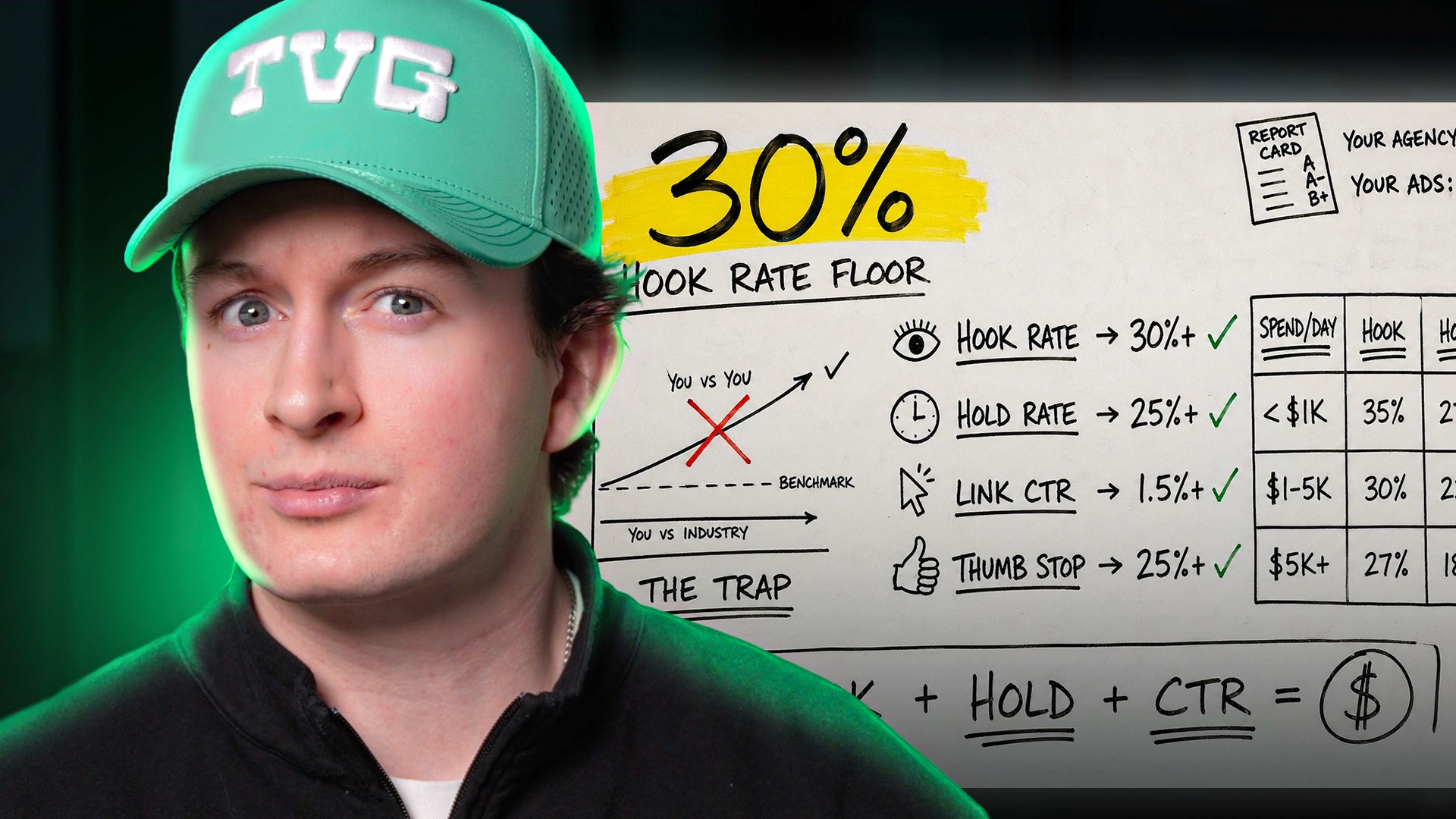
Historical benchmarking creates a self-sealing feedback loop. If a brand's hook rate averaged 18 percent last quarter and improves to 21 percent this quarter, that registers as a 16 percent gain. An agency can report this as a win. In context of the actual benchmark for a healthy hook rate -- 30 percent or above -- the brand went from significantly underperforming to slightly less underperforming. Neither number is competitive, but the trend line looks good.
This happens because agencies are structured to show improvement, and the easiest way to show improvement is to control the baseline you measure against. When the baseline is your own prior performance, there will almost always be some metric that went up. What is missing is the fixed external reference that tells you whether the absolute performance level is competitive with other brands running in the same channels.
Fixed external benchmarks answer a different question than historical comparison. Historical comparison asks: did we improve? External benchmarks ask: are we actually competitive? For brands trying to scale, the second question is the one that determines whether increasing spend produces efficient growth or just more expensive underperformance.
The Historical Benchmark Trap in Practice A brand whose hook rate moves from 18% to 21% over a quarter has a media buyer who can show improvement in the monthly report. Against TVG's external benchmark of 30% or above, that brand is still underperforming by nearly 10 percentage points. At $100,000 per month in ad spend, the gap between 21% and 31% hook rate is not a minor optimization -- it is a meaningful portion of the audience being lost before the creative delivers any message at all. |
The Four Creative Metrics That Actually Matter
TVG pulls four metrics on every creative across every ad account managed. These metrics together form a diagnostic map of how a creative performs at each stage of the viewer's experience: stopping the scroll, holding attention, and converting that attention into a click.
Metric | What It Measures | Good | Strong | Red Flag |
|---|---|---|---|---|
Hook Rate | % who watch past first 3 seconds | 30% or above | 35% or above | Below 25% |
Hold Rate | % who watch past the 50% mark | 25% or above | 30% or above | Below 15% |
Link CTR | % who click through to landing page | 1.5% or above | 2% or above | Below 1% |
Thumb Stop Rate | % who pause or interact with the ad | 25% or above | 30% or above | Below 20% |
Hook Rate
Hook rate is the percentage of people who watch past the first three seconds. It measures one thing: did the opening stop the scroll? The first three seconds are the only part of the creative that every viewer sees -- everything after depends on hook rate being high enough to hold their attention into the body.
A hook rate below 25 percent means the majority of the target audience is leaving before the creative says anything meaningful. The ad spend behind every impression delivered to that audience is partially wasted. Hook rate problems are almost always copywriting or visual problems -- the wrong opening frame, a hook that does not address a real pain point for the audience, or a visual that does not create enough pattern interruption to register differently from organic content in the feed.
HOOK RATE Good: 30% or above Strong: 35% or above Red flag: Below 25% -- the creative is not earning attention at the front end Root cause: Wrong opening frame, generic hook copy, visual that blends into feed rather than interrupting it |
Hold Rate
Hold rate is the percentage of viewers who watch past the 50 percent mark. A high hook rate with a low hold rate is a specific, diagnosable problem: the opening worked, but the body of the creative failed to deliver on what the hook promised. The story, claim structure, or pacing in the first 15 seconds after the hook is losing the audience that the opening captured.
A low hook rate with a normal hold rate means the opposite: the people who stay and watch are engaged, but not enough of them are staying because the hook is not performing. The two metrics read together point to the exact part of the creative where intervention is needed.
HOLD RATE Good: 25% or above Strong: 30% or above Red flag: Below 15% -- the creative pulled people in but lost them almost immediately High hook, low hold diagnosis: Body of creative is not delivering on the hook's promise; proof and supporting claims are arriving too late Low hook, normal hold diagnosis: The people who watch are engaged; the opening frame is the problem, not the story |
Link Click-Through Rate
Link CTR is the percentage of people who click through to the landing page. A creative can have a great hook rate, a great hold rate, and a weak CTR -- this combination almost always points to an offer or call-to-action problem, not a creative quality problem. The ad built desire but did not direct that desire toward an action clearly or urgently enough.
CTR below 1 percent on a creative with strong watch metrics means the creative is entertaining or informative but not driving purchase intent. The fix is usually a clearer, more explicit CTA that appears multiple times and a sharper offer frame rather than a rebuild of the creative concept.
LINK CTR Good: 1.5% or above Strong: 2% or above Red flag: Below 1% -- the creative watched well but did not convert attention into a click Common cause: CTA appears only once, at the end; offer is soft or implied rather than explicit; landing page message is mismatched to ad creative |
Thumb Stop Rate
Thumb stop rate measures the percentage of people who pause or interact with the ad while scrolling -- raw visual attention before any audio or copy plays. A low thumb stop rate means the creative is not even registering as worth a pause in the feed. Combined with a low hook rate, this signals a format problem: the creative's visual is not differentiated enough from organic content, or it looks so much like a traditional ad that the audience skips it reflexively.
THUMB STOP RATE Good: 25% or above Red flag: Below 20% -- the creative is being passed over before it starts Low thumb stop + low hook diagnosis: Format problem: visual is too similar to organic content or too obviously ad-like to earn a pause Fix direction: Test pattern interrupts in the first frame -- unusual visual formats, direct-to-camera openers, or high-contrast opening frames that look different from typical feed content |
What Good Looks Like at Each Spend Level
Creative benchmarks shift based on how much is being spent per day. This is not a flaw in the measurement system -- it reflects a real change in who the algorithm is reaching. At low spend, Meta reaches the warmest and most receptive part of the audience first. Performance looks strong because the easiest conversions are being found. As spend scales, the algorithm exhausts that warm segment and begins reaching progressively colder audiences. Metrics naturally compress, and expecting the same absolute numbers at $5,000 per day as at $500 per day will always produce inaccurate diagnoses.
Spend Level | Hook Rate Target | Hold Rate Target | Link CTR Target |
|---|---|---|---|
Under $1,000/day | 35% or above | 27% or above | 2.0% or above |
$1,000 to $5,000/day | 30% or above | 22% or above | 1.5% or above |
Above $5,000/day | 27% or above | 18% or above | 1.2% or above |
At under $1,000 per day, the brand is operating in a small, receptive pocket of the audience. Numbers at this level should be strong. This is also the right time to identify which creative concepts are worth scaling -- a hook rate of 35 percent at $500 per day provides signal that the concept has room to perform at higher spend, though absolute metrics will normalize as the audience broadens.
At $1,000 to $5,000 per day, natural decay in metrics is expected and normal. The algorithm is reaching a broader audience pool that includes colder prospects. Maintaining a 30 percent hook rate and 1.5 percent CTR at this spend level is strong performance. Brands that panic when metrics drop from $500-per-day levels are often pulling back spend that would have been profitable if held through the audience expansion phase.
Above $5,000 per day, creative diversity becomes more important than any individual metric. At this scale, individual creatives will fatigue as cold audiences are reached at volume. The metric targets are lower not because lower performance is acceptable, but because the audience composition has changed. The strategic response is a consistent rotation of net new creatives entering the account so that when any individual asset begins to decay, fresh creative is ready to carry momentum forward.
Why Brands Stall at Scale A common pattern: a brand scales from $1,000 to $5,000 per day, metrics look strong, they push to $10,000 per day. Metrics decay. They interpret the decay as a creative quality problem and pull spend back. The decay was actually normal audience exhaustion at scale -- the fix was more creatives, not less spend. Understanding spend-level benchmarks prevents this misread. |
Diagnosing What Is Wrong With a Specific Creative
When a creative misses benchmark at its spend level, the combination of metrics points to a specific root cause. The benchmarks identify that a problem exists. The metric breakdown identifies where in the creative the problem lives.
Metric Pattern | What It Points To |
|---|---|
Low hook rate, normal hold rate | Opening frame problem. The hook copy or visual is not stopping the scroll. Fix: rebuild the first 3 seconds -- new hook angle, visual pattern interrupt, direct-to-camera problem statement. |
Normal hook rate, low hold rate | Body of creative not delivering on the hook. Proof and supporting claims arriving too late. Fix: move social proof and specific claims into the first 15 seconds after the hook. |
Good hook + hold, low CTR | Offer or CTA problem. The creative is holding attention but not driving action. Fix: add a second explicit CTA earlier in the creative; sharpen the offer statement. |
Low thumb stop + low hook rate | Format problem. Creative looks too similar to organic content or too obviously like an ad. Fix: test unusual first-frame visuals, direct-to-camera openers, or high-contrast formats. |
All metrics below benchmark | Audience mismatch, wrong hook angle, or wrong offer for the audience. Fix: review targeting, test a different hook concept addressing a different pain point, or test a different primary offer. |
All metrics above benchmark | Creative is working. Scale spend at this spend level before introducing creative changes. |
How to Embed Benchmarks Into Creative Briefs
Knowing benchmarks is only useful if they change how creative gets built. The most direct application is embedding metric targets into every brief. Most creative briefs describe what an ad should look like -- tone, visuals, messaging, offer. A benchmark-driven brief goes further and tells the creator what they need to achieve, measured in numbers.
When creators know the specific metric they are building toward, they make structurally different decisions. The hook becomes intentional rather than instinctive. The pacing of the body gets tighter. The call to action gets placed earlier and stated more explicitly. The creative team is no longer guessing at what 'good' looks like -- they have a number to hit.
TVG adds the following four benchmark targets to every creative brief:
Hook Rate Target: 35% or above Opening 3 seconds must stop the scroll. Use a visual pattern interrupt or direct-to-camera problem statement. Hook must address a specific pain point -- not a general category benefit. Test at least two different hook angles per concept. |
Hold Rate Target: 25% or above First 15 seconds must deliver a specific claim, story beat, or proof point. Place social proof and supporting evidence in the body of the creative -- do not save it for the end. If a big claim is made in the hook, the next 12 seconds need to begin delivering the proof. |
Link CTR Target: 1.5% or above CTA must be explicit and appear at least twice: once in the middle third of the creative and once at the end. The offer must be stated clearly, not implied. Avoid soft CTAs like 'learn more' when the creative was built to drive a direct purchase. |
Thumb Stop Rate Target: 25% or above First frame must look visually distinct from organic content in the feed. Avoid static product shots as opening frames if feed content is typically lifestyle. Test high-contrast visuals, unexpected angles, or direct-to-camera in the first frame. |
When the creative comes back and misses a benchmark, the feedback conversation becomes specific rather than subjective. Rather than 'this creative isn't working,' the conversation becomes 'hook rate is 19 percent -- the first three seconds are not stopping the scroll, and the opening frame needs to change.' That instruction gives the creator or editor a targeted action rather than a vague direction to make it better. Over time, this specificity builds a creative team that iterates faster and reaches benchmark more consistently.
What Happens When the Brief Process Changes
TVG onboarded a supplement brand that had been running paid media for two years. Their previous agency had reported consistent month-over-month improvement throughout the engagement. When TVG ran the benchmark audit against external standards, the picture was different. Hook rate averaged 17 percent. Hold rate was 11 percent. CTR was 0.8 percent. Against historical performance, the trend looked fine. Against the benchmarks TVG holds every account to, the creative was underperforming across every metric.
Client Result: Supplement Brand -- Creative Benchmark Rebuild Hook rate from 17% to 31% in 60 days Hold rate moved from 11% to 24%. CTR moved from 0.8% to 1.7%. The creative team did not change. The brief template changed to include specific benchmark targets, and every creative review became a metric conversation rather than a taste conversation. Directional feedback shifted from 'the hook could be stronger' to 'hook rate is 19%, the first 3 seconds need a pattern interrupt -- recut the opening frame.' The specificity accelerated iteration speed and produced measurable improvement within two billing cycles. |
The intervention was not a creative overhaul -- it was a process change. Every brief included specific benchmark targets for hook rate, hold rate, and CTR. Every creative review was structured around metric performance rather than subjective creative preference. Feedback was precise: 'hook rate is 19 percent, the first three seconds are not stopping the scroll, that frame needs to change' rather than 'the opening feels slow.'
The creative team responded to specific instructions faster than to general direction. The improved metrics were a direct function of clearer expectations, not better talent or higher production budgets.
How to Audit Your Own Creative Right Now
Pull the last 30 days of creative data from Meta Ads Manager. For each asset, record hook rate (3-second video views divided by impressions), hold rate (video plays to 50 percent divided by impressions), and link CTR. Compare each number against the benchmarks for your current daily spend level.
Any creative running below the benchmarks for its spend level has a diagnosable problem. The combination of which metrics are low versus which are meeting benchmark tells you exactly where in the creative the issue lives -- and what to brief for the replacement asset.
For brands where this analysis reveals that most creatives are below benchmark across multiple metrics, the first fix is almost always the brief, not the production. Building the benchmark targets into every brief before the next creative batch is produced will produce better output from the same team with no additional cost.
Watch the Full Breakdown on YouTube
Patrick walks through all four creative metrics live, shows the exact brief template TVG uses, and shares how a supplement brand moved hook rate from 17% to 31% in 60 days.
Get a Free Core Growth Audit Our team will analyze your contribution margin, true CAC, LTV:CAC ratio, retention system, and MER -- and hand you a personalized roadmap showing exactly where you're bleeding, underleveraged, and ready to scale. No pitch. Just the numbers. |
|---|
About TVG
The Visionary Group (TVG) is a full-service e-commerce growth agency helping 7 and 8-figure Shopify brands scale profitably through paid media, creative strategy, email, and analytics. TVG spends and manages millions in Meta ad spend monthly across active brand partners.
Frequently Asked Questions
Common questions about creative benchmarks for Meta Ads, hook rate, hold rate, CTR, and how to use performance data to build better e-commerce creative.
Q1: What is hook rate in Meta Ads and what is a good benchmark?
Q2: What is hold rate and why does it matter?
Q3: What is a good CTR for Meta Ads creative?
Q4: What is thumb stop rate?
Q5: Why do creative benchmarks change at different ad spend levels?
Q6: How do I use creative benchmarks in a brief?
Q7: How should I give feedback on underperforming creative using metrics?
Q8: What happens when you fix the brief process without changing the creative team?
Our mission is to
Weekly breakdowns of what’s actually working in paid ads, email, and creative.
No spam, unsubscribe anytime.