Author
Patrick Driscoll, Co-Founder & CEO
Published Date
April 17, 2026
In 2025, our team conducted audits across 100+ e-commerce brands doing between $50,000 and $1,000,000 per month in revenue. Brands across every vertical: health and wellness, consumer electronics, apparel, home goods, DIY, and more.
We expected the fastest-scaling brands to be the ones with the biggest ad budgets, the most sophisticated tech stacks, or the most aggressive acquisition strategies. That is not what we found.
The brands compounding the fastest -- the ones growing top-line revenue while protecting or improving profitability -- shared one characteristic that had nothing to do with spend level or tool count. They had solved a problem that most high-growth brands never identify, let alone fix. A problem that quietly bleeds profit while every individual channel metric looks fine.
This article breaks down exactly what that problem is, why it is so common, and the structured system we built to solve it.
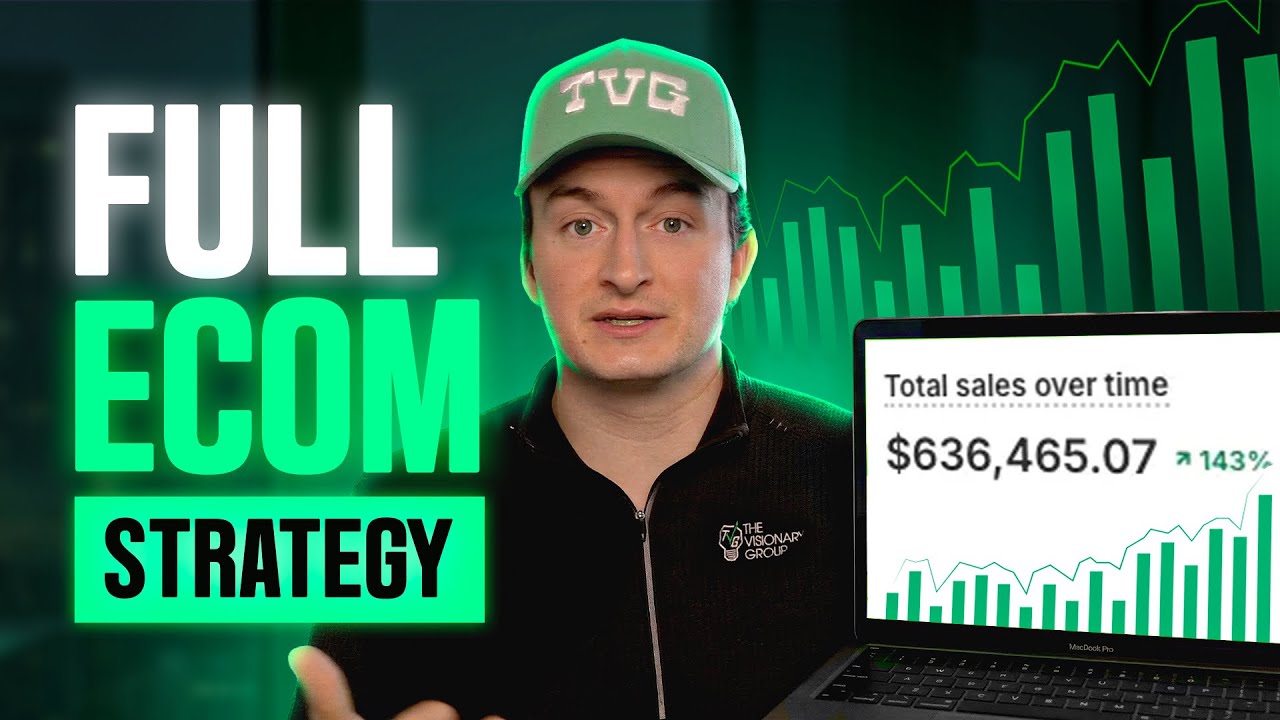
Watch the Full Audit Breakdown on YouTube
Patrick walks through the CORE Growth System with live client results and the exact diagnostics TVG runs on every brand audit.
The Real Reason Most E-Commerce Brands Plateau
Here is the pattern we see constantly with brands that have hit $500K to $5M per year and cannot seem to break through to the next level. They have proven product-market fit. They have consistent demand. They are generating real revenue. But growth slows, profit becomes unpredictable, and scaling starts to feel like pushing a boulder uphill.
The reason is almost always the same: the brand is operating in silos.
The Silo Problem Creative runs its own strategy. Paid media optimizes for ROAS. Email and retention operate completely independently. Everyone is maximizing their own piece of the puzzle -- but no one is looking at the full picture. Individual metrics look good on paper. The business leaks profit at every seam. |
|---|
When your channels are not talking to each other, you end up with a set of compounding inefficiencies:
Paid media acquires customers at cost, but retention does not convert them to repeat buyers -- so the full value of every acquisition dollar is never realized
Creative produces assets in isolation from conversion data, so ad spend tests messaging that the landing page experience contradicts
Email and SMS are treated as a broadcast channel rather than a profit system engineered around specific financial goals
Advertising dollars concentrate on the existing customer base, inflating reported ROAS while new customer growth stagnates
The result is a brand that is working harder and spending more, but only capturing a fraction of the revenue and profit it should be generating. At scale, this mismatch becomes extremely expensive.
The fix is not a new tool. It is not a better agency for one channel. It is system alignment: getting creative, paid media, retention, and financial data to operate as a single, integrated growth engine instead of four separate functions optimizing in different directions.
What Happens When the Whole System Aligns
This is not theoretical. Here is what system alignment produced for four different brands with four different challenges.
CLIENT RESULT: Peaky Hat 143% revenue growth. 189% profit increase. 90 days. Before working with TVG, Peaky Hat had strong individual channel performance but disconnected strategy across creative, paid, and retention. Aligning the full system in the first 90 days produced both top-line growth and a near doubling of profit -- simultaneously. |
|---|
CLIENT RESULT: Burnt Toast 86% increase in average order value year-over-year. The problem was not the ads. It was that creative, email, and the website were not telling the same story. TVG aligned the creative strategy with the entire customer journey -- ads, emails, and site experience all reinforcing the same brand and offer. AOV scaled 86% as a result of that cohesion, not from any single channel change. |
|---|
CLIENT RESULT: 8-Figure Consumer Electronics Brand $2.5M in Q4 sales. 16x Marketing Efficiency Ratio. 38% CAC reduction. Their ad strategy was optimized for ROAS, which meant the budget was heavily weighted toward their existing customer base. Inflated ROAS numbers, but almost no new customer growth. TVG rebuilt the paid strategy around unit economics and true new customer CAC. The result was $2.5M in Q4 revenue at a 16x MER while cutting customer acquisition cost by 38%. |
|---|
CLIENT RESULT: DIY Craft Brand 66% revenue growth. 44% new customer growth. 50%+ profit margins maintained. This brand had been working with an ads-only agency optimizing for ROAS. When TVG stepped in and looked at the entire system -- creative, paid, retention, and unit economics together -- it became clear they were leaving significant revenue on the table. Sustainable scale required all four levers working together. The result was rapid revenue growth without sacrificing the profit margins that made the business viable. |
|---|
The CORE Growth System: A Framework for Aligned Scale
The CORE Growth System is the structured methodology TVG built to align every channel of an e-commerce brand around a single north star: profitable, predictable revenue growth. Here is what each component means in practice.
C -- Conversion-Driven Creative |
|---|
Most brands think they have a creative problem. What they actually have is a creative alignment problem. They are testing UGC, graphics, and statics without connecting creative performance to the downstream outcomes that matter: conversion rate, average order value, and customer lifetime value. Conversion-driven creative means every asset, every message, and every offer is built with one purpose: profitable customer acquisition. That requires creative that is tested against contribution margin data, aligned with the landing page experience, and consistent across every touchpoint from ad to email to site. In the post-Andromeda era, creative volume alone is not enough. Creative that is strategically aligned with your full funnel is the differentiator. |
O -- Optimized Paid Advertising |
|---|
Optimized paid advertising does not mean better ROAS. It means media buying that operates on your actual unit economics. The most common problem we identify in brand audits is ad spend concentrated on existing and engaged customer segments -- audiences that convert easily and make ROAS look great, but do not grow the business. True paid media optimization means knowing your allowable CAC based on contribution margin and LTV, prospecting aggressively to net new audiences, and scaling spend in direct proportion to the LTV:CAC ratio the business can support. When paid media is aligned with the financial architecture of the business, scaling stops feeling like gambling and starts working like a system. |
R -- Retention as a Profit Center |
|---|
Retention is not an afterthought. For any e-commerce brand with repeat purchase potential, it is the primary profit lever. The economics are simple: every customer your retention system converts into a second, third, or fourth purchase is a customer you did not have to pay CAC to reacquire. That compounds directly into LTV:CAC ratio and, by extension, into how aggressively you can scale acquisition. Engineering retention with financial intent means your welcome series is optimized for payback window, your post-purchase flows are optimized for second-order velocity, your SMS is active and sequenced, and your cross-sell strategy is mapped to product cadence. Email and SMS at 30 to 45% of total revenue is not a ceiling -- it is a minimum for a retention system that is actually doing its job. |
E -- Expansion and Scale |
|---|
Once the core fundamentals are aligned, the question becomes: how do you scale top-line revenue without sacrificing profitability? Sustainable expansion is not about increasing budget. It is about understanding the unit economics deeply enough to know exactly how much more you can spend per channel, per audience, and per offer before margin compresses. TVG uses a growth dashboard that tracks contribution margin, MER, LTV:CAC, and true new customer CAC in real time across every active channel. Scaling decisions are made from that dashboard -- not from platform ROAS reports. That is the difference between incremental budget increases that erode profitability and structured scale that builds enterprise value. |
Why Most Agencies Cannot Solve This Problem
The silo problem is not an accident. It is a structural consequence of how most agencies are built.
A paid media agency optimizes for paid media metrics. An email agency optimizes for email metrics. A creative agency produces creative assets. Each is doing exactly what they are contracted to do. But none of them has the visibility -- or the incentive -- to look at how all the pieces interact.
The result for the brand is exactly the disconnected system described above, even when every individual agency is technically delivering on their KPIs.
The Typical Agency Model | The CORE Growth System Approach |
|---|---|
Channel-specific focus (ads only, email only) | Full-funnel ownership across creative, paid, retention, and analytics |
Optimizes for platform metrics (ROAS, open rate) | Optimizes for business metrics (contribution margin, LTV:CAC, MER) |
Junior account managers or offshore execution | Senior growth strategists with hands-on implementation |
Recommendations without implementation | Operators who build and run the system |
No view into the full financial picture | Unit economics and P&L review built into every scaling decision |
The Free Core Growth Audit: What It Includes
The Core Growth Audit is the diagnostic that precedes every TVG engagement. It is the same analysis our team runs internally before making any recommendations on creative strategy, paid media, or retention architecture.
The audit includes:
Full-funnel diagnostic: Meta, Google, and Klaviyo performance reviewed against true unit economics, not platform-reported metrics
Unit economics mapping: Contribution margin by offer, true new customer CAC, LTV:CAC ratio, and MER calculated across your actual business data
Retention system review: Email and SMS revenue percentage, list health, flow architecture, and repeat purchase mechanics assessed against best-in-class benchmarks
Growth constraint identification: The specific bottleneck holding your brand back from profitable scale -- identified, prioritized, and mapped to a concrete action plan
Personalized growth roadmap: Delivered within 3 to 5 business days, built for your brand's specific financial profile and growth stage
Worst case: you get an honest, expert perspective on your business from a team that works inside 7, 8, and 9-figure brands every day, with a clear plan you can execute on your own. Best case: you find the growth system that makes scaling predictable.
Capacity Note TVG completes 5 to 10 audits per week. This is a deliberate constraint -- each audit requires significant senior team time to do properly. If you are serious about understanding what is actually holding your brand back, apply early. |
|---|
Frequently Asked Questions
Why can't my e-commerce brand scale profitably even with strong revenue?
What is a good LTV:CAC ratio for e-commerce?
What is Marketing Efficiency Ratio (MER) and why does it matter more than ROAS?
What is the difference between true CAC and CPA?
What is contribution margin and how do I calculate it for my Shopify brand?
What financial metrics should I track to scale my e-commerce brand?
Why do most e-commerce brands fail to scale past a certain revenue ceiling?
How do I know if my e-commerce brand is ready to increase ad spend?
Apply for a Free Core Growth Audit (Limited Spots) A $3,000 value. No pressure. No obligation. Our senior team -- currently working inside 7, 8, and 9-figure brands -- will complete a full-funnel diagnostic across Meta, Google, and Klaviyo, map your unit economics, and hand you a personalized growth roadmap within 3 to 5 business days. We only complete 5 to 10 audits per week. Apply below to see if your brand qualifies. Apply for Your Free Core Growth Audit at thevisionarygrouptx.com |
|---|
Watch the Full Audit Breakdown on YouTube
Patrick walks through the CORE Growth System with live client results and the exact diagnostics TVG runs on every brand audit.
Our mission is to
Weekly breakdowns of what’s actually working in paid ads, email, and creative.
No spam, unsubscribe anytime.